

The urgent need to prevent pesticide suicides took centre stage at a side-event during the 79th World Health Assembly in Geneva.
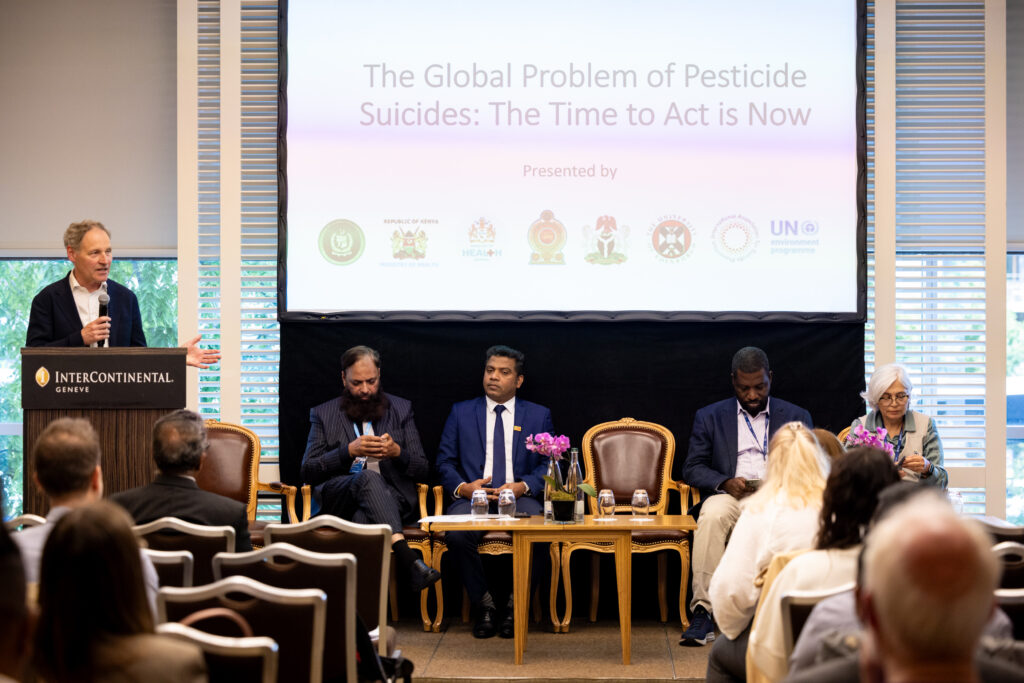
Held on Wednesday 20 May 2026, the session ‘The Global Problem of Pesticide Suicides: The Time to Act is Now’ brought together policymakers, technical experts and global stakeholders to share experiences and call for further action to prevent deaths from pesticide self-poisoning.
With pesticide poisoning responsible for 20% of all global suicides, attendees heard how many lives could be saved through stronger pesticide regulation.
The event was organised by Sri Lanka, Guyana, Kenya, Nigeria & Pakistan, in collaboration with UNEP, International Association for Suicide Prevention and the Centre for Pesticide Suicide Prevention.
Throughout the session, five key themes emerged.
1. Pesticide suicide is a global crisis
The event challenged the common misconception that pesticide suicide is primarily a South Asian issue. With speakers sharing experiences from Asia, Africa and South America, it was clear that this is a global problem.
There were repeated calls for stronger international cooperation on pesticide regulation, alongside recognition that efforts by individual countries can only go so far. To bring an end to pesticide suicides, acutely toxic highly hazardous pesticides must be banned by all, as products regulated in one country may still enter illegally from neighbouring countries where they remain available.
2. Pesticide bans save lives
Alongside recognition of the problem’s global scale, speakers also highlighted compelling evidence that pesticide regulation works.
Sri Lanka is often regarded as the leading example for this intervention, with an estimated 93,000 lives saved following a series of pesticide bans in the 1980s and 90s. Sharing their ‘blueprint’, Sri Lanka’s Minister of Health and Mass Media explained that success did not come from a single intervention. Instead, it resulted from a long-term, evidence-based approach built on continuous surveillance and data collection.
In addition to a staggering fall in suicide deaths, Sri Lanka’s experience also disproved claims that pesticide bans harm agricultural productivity. The Minister noted that there had been no measurable impact on agriculture and crop production following the introduction of the bans.
Bangladesh shared a similar experience, having banned all WHO Class I highly hazardous pesticides 25 years ago. Their representative described ongoing efforts to ban another lethal pesticide that has been identified as responsible for a significant number of deaths.
3. The importance of data and decriminalisation of suicide
The importance of reliable data emerged as another central theme of the discussion.
Having been tasked with presenting global data on pesticide suicide, Richard Brown of the World Health Organization highlighted the challenge of understanding the full scale of the problem. He described global data on intentional pesticide poisoning as “a gap”, while warning that the true number of deaths is likely to be substantial.
Country representatives further reinforced this message. Speakers from Nigeria and Pakistan described ongoing challenges with underreporting, and highlighted steps taken to decriminalise suicide. They emphasised that reducing stigma is essential to improving reporting and better understanding the true scale of the problem.
4. A cross-sector challenge requiring coordinated action
The conversation also reinforced that pesticide suicide prevention cannot be addressed by the health sector alone. Speakers emphasised that both the problem and its solutions cut across health, agriculture and environmental policy.
With pesticide bans widely recognised as the most effective way to prevent deaths, Health Ministers and WHO country-office representatives spoke about the importance of collaboration with Ministries of Agriculture, whose action is ultimately required to enact bans.
The event was co-hosted by the UN Environment Programme, with their representative making it clear that this was also an environmental issue. Speaking on behalf of UNEP, Jacqueline Alvarez reflected on growing up in a country where pesticides were often called ‘medicine’ for crops. She noted, however, that pesticides can also cause significant harm to soil health and the wider environment, stressing the need for stronger environmental policies.
She also emphasised the role of biodiversity laws and cross-sector initiatives, including the Global Alliance on Highly Hazardous Pesticides, in driving change.
5. A preventable problem
Throughout the event, one key message was reiterated time and time again, that suicide is preventable.
In the case of pesticide suicides, which are often impulsive and linked to access to lethal means of suicide in a moment of crisis, it was emphasised that we have a clear and practical solution.
As Mark Van Ommeren of the World Health Organization noted, this is the one area of suicide prevention that is not complex. We have an evidence-based solution that works. We now need to see countries implement bans on acutely toxic highly hazardous pesticides and lives will be saved.
Closing the event on a positive note, Professor Flemming Konradsen offered a clear call to action, stating “here we can act”.
What next?
The side-event reinforced the message that pesticide suicide is a significant, global issue which requires strong international action. The solution is straightforward, with evidence showing that bans on acutely toxic highly hazardous pesticides save lives.
The focus must now be on cross-sector action, with Ministries of Health, Agriculture and Environment working together to restrict access to the world’s most harmful pesticides.
The Centre for Pesticide Suicide Prevention called on countries to sign to a joint ministerial statement, committing to the progressive restriction or elimination of highly hazardous pesticides for suicide prevention.
Watch a recording
Further information
CPSP also supported an official side-event at the 79th World Health Assembly, ‘A Global Pursuit of Suicide Prevention: Turning Evidence into Action’.
This event brought together Ministers of Health, policymakers, and experts to discuss evidence-based approaches to suicide prevention. Pesticide self-poisoning, and the effectiveness of pesticide bans, was a recurring discussion point throughout the session.
A summary and recording of this official event is available on our website.