

Following CPSP’s recognition at the recent University of Edinburgh Impact Awards, Ellie Roger reflects on the importance of research impact – where research leads to real-world change.
*Warning: this article contains content about suicide and self-harm. To access help and support, please visit www.findahelpline.com*
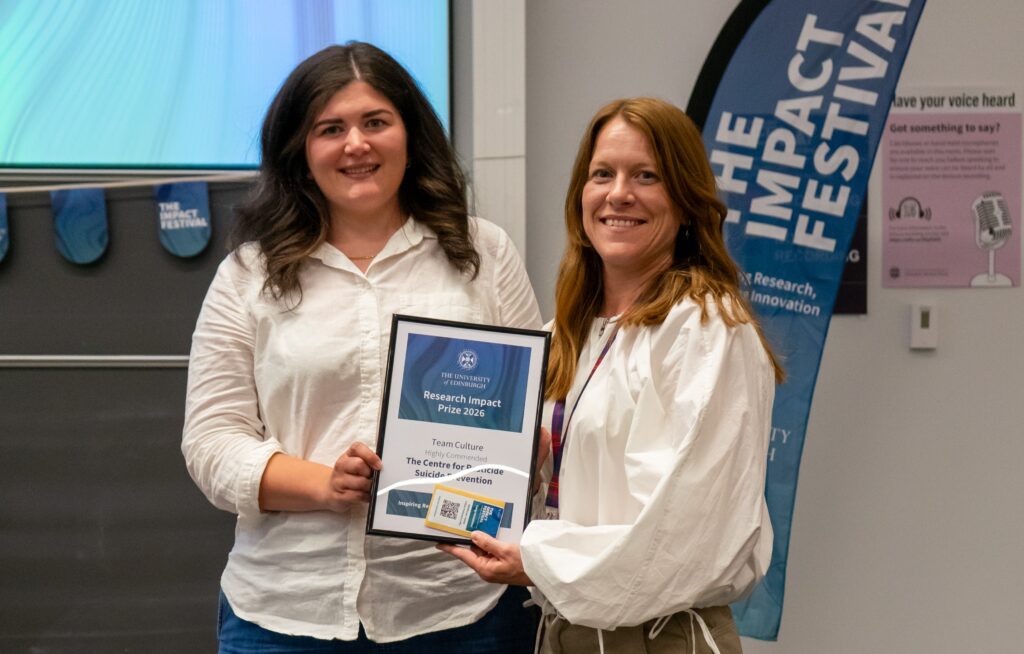
I often describe the Centre for Pesticide Suicide Prevention (CPSP) as an ‘anomaly’ at the University of Edinburgh.
While many of my science communication colleagues work in research centres, spending their days sharing the latest discoveries emerging from the laboratories, I have very little new research to share.
CPSP instead describes itself as a ‘policy and research initiative’. Yes, we still do research, however our main focus is now on impact.
In our case, we want to see global policy change. Specifically, we want to save lives through bans on toxic pesticides.
Building an evidence base
I am not undermining the importance of research. It is, of course, crucial and the bedrock of all we do. After all, CPSP is built on over thirty years of research.
It began in the wards of a Sri Lankan hospital, where a young Michael Eddleston first came across the problem of pesticide suicides. Day after day, he watched people die from intentional pesticide poisoning, with very little he could do to save them.
As both a clinician and a researcher, his first instinct was to find new and better treatments. However, he quickly discovered that new treatments are not easy to develop. Those that were tested, failed to improve survival rates.
His next step was to explore whether ‘safe’ storage of pesticides could prevent deaths. He ran a huge trial in Sri Lanka, with locked boxes and training provided to thousands of farmers. The evidence was conclusive – it did not work.
Then, he began to support the work of the pesticide regulator in Sri Lanka, who had taken steps to ban lethal pesticides. Here, for the first time, he started to see success. The results were incredible, with Sri Lanka recording a 70% fall in their overall suicide rate. Crucially, the research also showed that crop production was not adversely affected.
Since then, other countries have taken similar steps, and the results have been the same. Lives have been saved, with no impact on agriculture. The conclusion: pesticide bans work.
The move from research to impact
When I first met Michael, it was clear that his motivation was to save lives.
From his perspective, research was no longer the top priority. The evidence base already exists, what we need now is action.
It was this need for action that led to the establishment of CPSP in 2017.
We are fortunate to be funded through effective altruism sources, which have recognised pesticide bans as an extremely cost-effective way to prevent deaths.
The centre’s main focus is now on policy engagement, supporting pesticide regulators across the globe to bring in bans on deadly pesticides.
Our work has already directly led to bans in Nepal, India, China, Tanzania and Bangladesh. We expect these to save thousands of lives every year.
The role of the university
Despite our move away from research, CPSP continues to be part of the University, being guided by its policies and procedures.
This is important. The University crest provides credibility and helps to establish trust with global collaborators. We are not just another advocacy organisation; we are rooted in world-class research and evidence.
This is how it should be. Universities are home to fantastic researchers whose work has the potential to change and shape the world for the better. For this to happen, they must be allowed and supported to develop impact from their research.
At the University of Edinburgh, I have seen a shift in recent years towards impact. A new impact and engagement team has been established, there is an annual Impact Festival and award ceremony to share best practice, and University-wide networks support public and policy engagement.
I have also discovered that we are not alone. Other initiatives like us exist, including Childlight, which uses data to engage and support government action on child sexual exploitation.
A change in priorities
Previously, researchers were incentivised to prioritise research papers in high impact journals and count citations. These have driven much longed for ranking points – bringing prestige and funding to universities. These have also helped researchers to establish and build their individual reputations.
But what is the point of publishing a paper if it makes no difference in the real world, beyond academia? When there is evidence to support action, shouldn’t this be a priority? Or better still, shouldn’t impact be considered throughout the research process?
CPSP’s research is now shaped by our policy engagement. Working in collaboration with policy makers, we are able to understand what data exists and the gaps that need filled. It is often only through collaborations with Ministries of Health or Agriculture that we are able to access official data on pesticides poisoning cases and suicides.
By involving policymakers in the research process, it is also far more likely that they will accept and act on the findings.
Universities, like the University of Edinburgh, are now placing more emphasis on research impact. This is good to see. Perhaps, in the future, the Centre for Pesticide Suicide Prevention will no longer seem like such an anomaly.
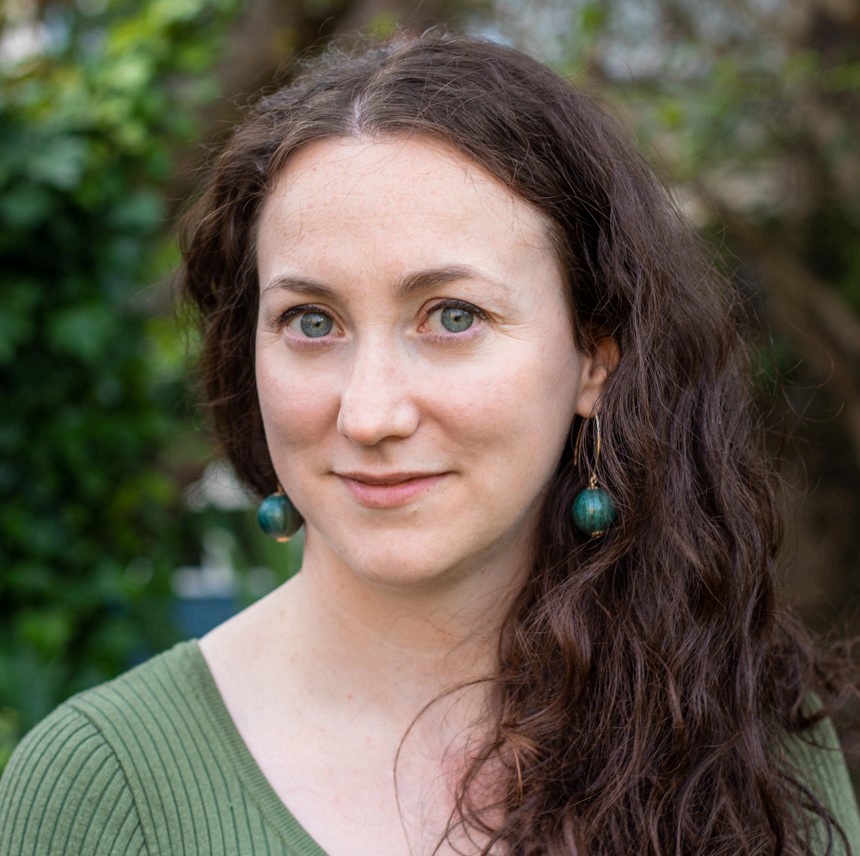
CPSP Communication & Development Officer
Ellie Roger is an experienced communications, events and engagement professional with over 15 years of experience working in the not-for-profit sector. She joined CPSP in January 2022 to provide communications support for the centre, helping to raise the profile of both pesticide suicide and CPSP’s work.